

Panellists chat materiality, enforcement at CA ANZ sustainability conference

By Emma Partis
1 December 2025 • 3 minute read
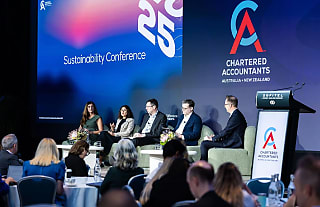
Last Tuesday (25 November), panellists at the CA ANZ Sustainability Conference shared insights on how to assess materiality in the context of climate-related financial reporting and regulators’ approach to enforcement in the early stages of the regime.
Samantha Sing Key, sustainability reporting advisory partner at Grant Thornton, reminded delegates that ‘materiality’ in the context of climate reporting was related to the capacity of information to shape user decisions rather than the materiality of climate risks themselves.
“This definition is actually about the concept of material information for the user,” she said in a keynote speech.
“I just want to stress here that this piece of information that we're talking about is not actually the risk itself, it is the information about that risk which is subject to a materiality consensus.”
To assess whether climate risk information was material or not, Key recommended that preparers should consider whether such information would be readily available to stakeholders outside of the organisation, and whether it would influence their decisions.
“We are talking about the people who do not have the internal knowledge of the entity who are going to be relying upon this information to make decisions in relation to contributing economic resources to an entity over the short, medium and long term,” Sing Key said.
“Would someone outside of the entity who is thinking about potentially transacting with this entity know this information? And if they did know that information, would they change their decision if that information was omitted or misstated?”
Panellist Claire LaBouchardiere, the lead of the ASIC’s sustainability, financial reporting and audit team, noted that the reporting requirements had been put in place to inform investors, and that this would shape materiality considerations.
“It's important that we keep in mind the objective and the purpose of the reporting requirements, which really is about better user decision making,” she said.
“It really is about thinking about why the ISSB [International Sustainability Standards Board] was established, why the standards were put into place, which was that call from investors for high quality, globally consistent and comparable information about climate risks and opportunities over the short, medium and long term.”
When asked how regulators would assess businesses that had concluded they faced no material climate risks, LaBouchardiere said that firms would need to document their decision-making process adequately to support that position.
“If the view is formed that there are no material climate risks or opportunities, it's really important that you are documenting that and you've got really firm records to explain how you have formed that view,” she said.
“There are a range of risks and opportunities that will affect all sizes and shapes of companies. So I think you need to very carefully come to the view that there are no material risks and opportunities and really have a strong basis for that conclusion.”
Renee Meimaroglou, assistant auditor-general at the NSW Audit Office, also urged firms to dedicate adequate resources to their climate risk and opportunity assessments.
She strongly recommended that agencies talk to as many people as possible to inform their risk assessment, including board members, legal representatives, chief risk officers and relevant governing bodies.
“I have observed some cases where climate risk and opportunity assessments are being conducted just by one person,” Meimaroglou said.
“When agencies are conducting that climate risk and opportunity assessment, that's essentially the backbone of your climate disclosure. So it needs a lot of thought and a lot of consultation.”
As companies adapt to the new climate financial reporting requirements, regulators have reiterated that they would focus on supporting rather than penalising businesses as they adjusted to the new regime.
“As the regulator, we recognise that this will take time. So it will take time for businesses to put in place the systems and processes and develop capabilities. It will take time to make sense of the information and think about how they're going to use it to its full potential,” ASIC’s LaBouchardiere said.
“And so for us, as the regulator, we have said that we will be pragmatic in the way that we supervise and administer the new obligations. So our focus will very much be about how we can support companies on the journey towards implementation.”
Meimaroglou said the NSW Audit Office would take a similar approach to assurance during the initial adjustment period.
“From an assurance perspective, I keep on saying to our team at our audit office, don't expect the agencies to provide you with gold plated disclosures,” she said.
“It is the first year they are starting. It is a journey, and it is about understanding that there will be gaps. But that's okay as long as those gaps are being disclosed and how plans to address those going forward are included.”
Want to see more stories from trusted news sources?
Make Accounting Times a preferred news source on Google.
Click here to add Accounting Times as a preferred news source.
Emma Partis
AUTHOR
Emma Partis is a journalist at Accountants Daily and Accounting Times, the leading sources of news, insight, and educational content for professionals in the accounting sector. Previously, Emma worked as a News Intern with Bloomberg News' economics and government team in Sydney. She studied econometrics and psychology at UNSW.
KNOW MORE